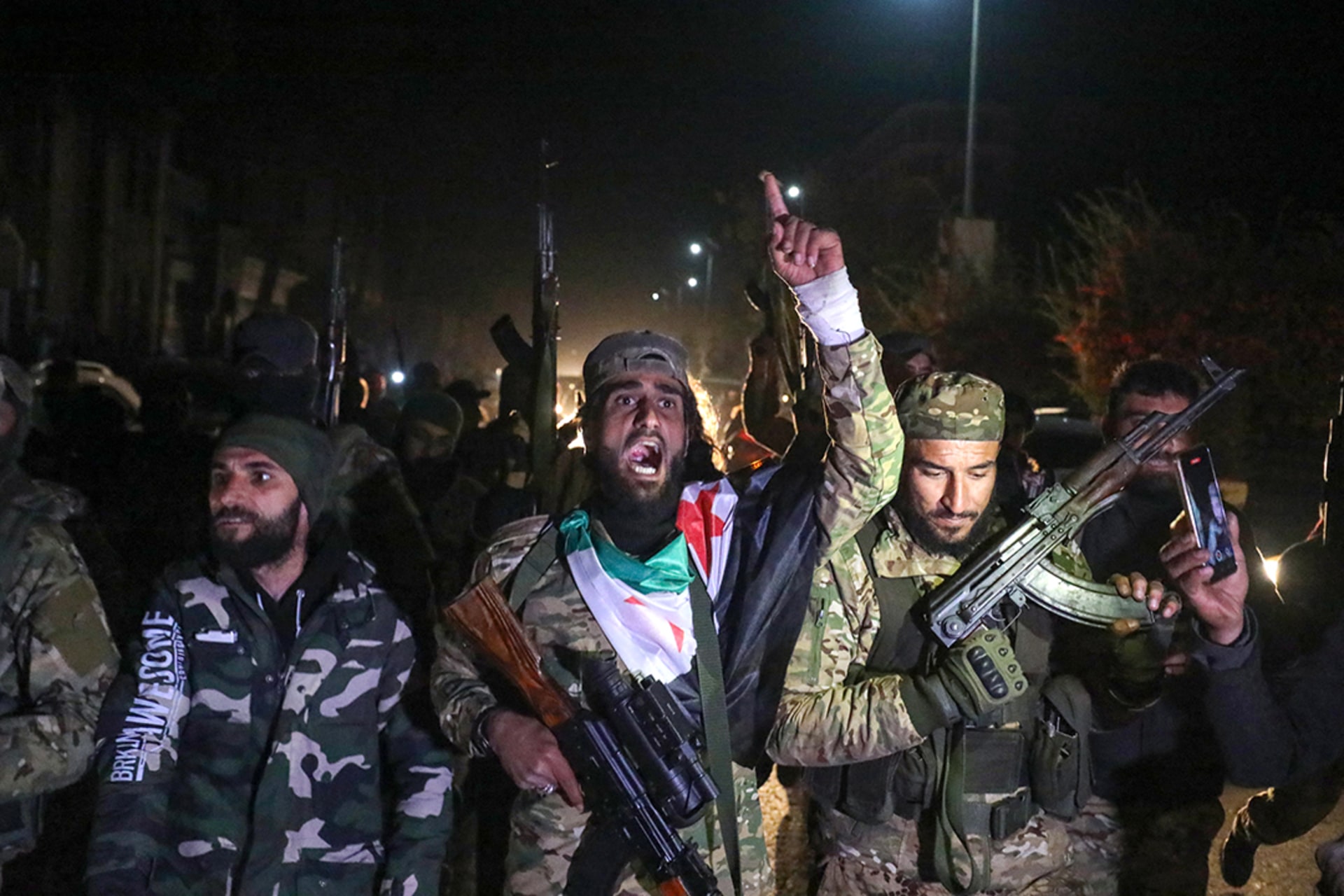
Islamist-led Syrian rebel fighters celebrate in the streets of Homs in the early hours of December 8, 2024, after entering Syria’s third city overnight.Abdulaziz Ketaz/AFP via Getty Images
TYPE
Political Instability
IMPACT ON U.S.
Low
STATUS
Unchanging
Related
Syria
Updated August 26, 2026
RelatedSyria
Updated August 26, 2026
Overview
Since the ouster of the Bashar al-Assad regime in December 2024, Syria has entered a fragile transition under Ahmed al-Sharaa, the leader of Hayat Tahrir al Sham (HTS), a group that the United States had designated as a terrorist organization until July 2025. With a five-year transitional period underway, the path to a stable Syrian state depends on unresolved questions of minority rights, Kurdish military integration, constitutional reform, and a security arrangement with Israel.
Islamist-led Syrian rebel fighters celebrate in the streets of Homs in the early hours of December 8, 2024, after entering Syria’s third city overnight.Abdulaziz Ketaz/AFP via Getty Images
Two Syrian Pipelines Damaged in Separate Incidents
Syrian state media reported that a gas pipeline and a petroleum products pipeline belonging to the state-owned Syrian Petroleum Company sustained damage in separate incidents; the company described the gas pipeline explosion as an act of sabotage and attributed the other leak to attempted fuel theft (Al Jazeera).
Israeli Forces Shell Syrian Countryside
Israeli forces launched three shells targeting an area near Tal Krum in the Quneitra Countryside (Al Jazeera).
Israeli Forces Search Syrian Village
Israeli forces searched the village of Rasm al-Haydarah in the Quneitra countryside (Al Jazeera).
Syria’s UN Ambassador Condemns Israeli Incursions and Demands Withdrawal
Syria’s ambassador to the UN, Ibrahim Olabi, addressed the UN Sixth Committee, condemning Israel’s activities within Syria’s borders, asserting that they undermined state security, and demanding a full withdrawal from occupied Syrian territory (Al Jazeera).
Israeli Forces Shoot and Kill Syrian Man in Quneitra
Israeli forces shot and killed a Syrian man near al-Hamidiyah in the Quneitra governorate after he reportedly approached an Israeli military position (Al Jazeera).
Syria’s Civil War (2011-24)
What began as protests against President Assad’s regime in 2011 quickly escalated into a full-scale war between the Syrian government and anti-government rebel groups. Three campaigns drove the conflict: coalition efforts to defeat the self-proclaimed Islamic State (ISIS), violence between the Syrian government and opposition forces—a broad coalition that included the Free Syrian Army, Islamist groups like Ahrar al-Sham and Jaysh al-Islam, and later HTS, and military operations against Syrian Kurds by Turkish forces.
The self-proclaimed Islamic State began seizing control of territory in Syria in 2013. After a series of ISIS-coordinated terrorist attacks across Europe in 2015, the United States, the United Kingdom, and France—with the varied support of Arab partners—expanded their air campaign against ISIS in Iraq to include Syria. Together, those nations have conducted over eleven thousand air strikes against ISIS targets in Syria, while the U.S.-led coalition against the Islamic State supported ground operations led by the SDF. Turkish troops have been involved in ground operations throughout Syria since 2016 and have launched attacks against armed Kurdish groups in Syria.
At the request of the Syrian government, Russia began launching air strikes against anti-government forces in September 2015, while Syrian government forces achieved several notable victories over the Islamic State, including the reclamation of the city of Palmyra. According to the U.S.-led coalition against the Islamic State, Iraqi security forces and the SDF reclaimed 98 percent of the territory formerly held by the group in Iraq and Syria, including the cities of Raqqa and Deir al-Zour.
With Russian and Iranian support, the Syrian government steadily regained control of territory from opposition forces, including the opposition’s stronghold in Aleppo in 2016. The regime was accused of using chemical weapons numerous times over the course of the conflict, with particularly significant incidents resulting in international condemnation in 2013, 2017, and 2018. In response to the 2017 and 2018 attacks, the first Trump administration launched strikes against the Assad regime, targeting Shayrat Airbase in 2017 and chemical weapons facilities in 2018. Opposition forces maintained control in Idlib, in northwestern Syria, and on the Iraq-Syria border. During this period, efforts to reach a diplomatic resolution with the Assad regime were unsuccessful. Various rounds of UN-backed peace talks in Geneva failed to reach a political resolution, while a ceasefire reached in Astana, Kazakhstan, collapsed after Syrian government forces violated its terms.
By 2023, the Assad regime was attempting to reemerge from years of diplomatic isolation. This culminated in the Arab League agreeing to re-admit Syria after a twelve-year suspension. HTS remained confined to Idlib for several years, leading most regional analysts to believe the threat to Assad had largely ended, even as sporadic ISIS attacks and targeted Israeli strikes on Iran-backed militias continued.
According to UN estimates, at least 580,000 people were killed during the civil war, tens of thousands disappeared, and over half the population was either internally displaced or living as refugees in Jordan, Lebanon, Turkey, and several European states. On February 6, 2023, a 7.8 magnitude earthquake struck northwest Syria and southeastern Turkey in one of the worst natural disasters of this century. In Syria, the disaster killed an estimated 8,400 people and caused about $5.1 billion in damage, deepening the humanitarian crisis.
Overthrow of Bashar al-Assad (2024)
Battlefield dynamics in Syria shifted significantly following Hamas’s October 7, 2023, attack on Israel. Israel accelerated its airstrikes in Syria, killing multiple senior officials within Iran’s Islamic Revolutionary Guard Corps (IRGC) and weakening the Hezbollah-led militia’s efforts to maintain Iran’s strategic depth throughout Syria. After Israel launched a ground invasion and large-scale aerial campaign against Hezbollah in Lebanon in September 2024, the group significantly scaled back its presence in Syria. Likewise, the Russian invasion of Ukraine forced Russia to shift forces away from its bases in Syria.
By November 2024, the degradation of the Iranian proxies that supported Assad provided a military opening for Syrian rebel groups like HTS to renew their campaign against the Assad regime. In contrast to the declining influence of the regime’s allies, the rebels had continued receiving military support from Turkey, which maintained troops in northern Syria and helped create the Syrian National Army (SNA), a key rebel group responsible for attacks against the SDF and others. As the November offensive began, Assad’s forces fought back with minimal firepower. After capturing Aleppo, rebel forces seized Hama on December 5, Daraa on December 6, and Homs on December 7, before overpowering Assad’s fleeing forces in Damascus on December 8. Throughout their offensive, the rebels freed thousands of political prisoners held by the Assad regime. The offensive’s speedy success against the Assad regime’s forces surprised many observers, including analysts, Syrians, and even the rebels themselves.
Transition Under Ahmed al-Sharaa (2024-Present)
As Assad fled to Moscow and many Syrians celebrated the rebels’ announcement of victory on state television, a new interim administration emerged under the leader of the rebel group Hayat Tahrir al-Sham (HTS), Ahmed al-Sharaa. Al-Sharaa founded HTS as a successor group to Jabhat al-Nusra, which was al-Qaeda’s Syria affiliate before breaking off in mid-2016. Those ties, as well as his long-standing personal ties to al-Qaeda, prompted the United States to designate Al-Sharaa as a terrorist. HTS imposed strict Islamist governance in Idlib province prior to 2024, raising concerns about how an Islamist-led government would treat Syria’s diverse religious and ethnic communities. Still, the United States and many European governments cautiously welcomed the change in government, calling for the new regime to implement an inclusive political solution aligned with UN resolutions.
Since then, the Sharaa regime’s record has been mixed. His government has suggested it is committed to a political process that reflects equality among Syria’s diverse population, but many minority communities feel sidelined and fearful of the new regime. Women and minorities won only a few seats in the October 2025 parliamentary elections, while the new interim constitution risks centralizing power without credible institutional guarantees of civil and political rights.
Although the regime promised to avoid retribution against the Alawite minority, which Assad’s rule had favored, it struggled to contain a vigilante assault that killed an estimated 1,400 members of the community, predominantly civilians, in March 2025. A Reuters investigation traced much of the violence to units integrated into the new government’s security apparatus. In southern Syria, meanwhile, the Druze population accused Damascus of backing Bedouin tribes in deadly clashes over the summer of 2025, which killed at least 1,000 people.
In March 2025, the Sharaa regime signed an agreement with the SDF to integrate elements of the Kurdish and Arab populations in the northeast into government structures. However, clashes resumed after the deal failed to be implemented by year’s end. On January 13, 2026, government forces launched a major military offensive against SDF territory and communities, capturing approximately 80 percent of northeast Syria, including prison camps housing tens of thousands of ISIS detainees and their families. Turkey’s interest in preventing Kurdish autonomy further complicated the process, as Ankara threatened military escalation and provided support to Damascus during the offensive.
Following the offensive, a preliminary ceasefire was announced on January 18, 2026, and the SDF agreed to transfer administrative control of the region to the central government in a more comprehensive U.S.-mediated ceasefire on January 30, 2026. While the January 30 agreement offered Kurdish groups less political autonomy than had been negotiated in March 2025, it represented significant concessions compared with the preliminary January 18 ceasefire. The deal allows for the integration of SDF divisions as whole units, though implementation faces challenges. In a separate unilateral declaration, Sharaa granted Kurdish Syrians rights for the first time, including the formal recognition of the Kurdish language and the restoration of citizenship to Syrian Kurds.
In expressing support for the ceasefire deal, U.S. envoy Tom Barrack stated that the United States no longer views the SDF as its primary partner in countering ISIS, marking a significant shift in U.S. policy. During the Obama administration, the United States and SDF had become close military allies, with Kurdish forces bearing heavy casualties in the fight against ISIS. However, Washington began transferring ISIS detainees to Iraq after multiple prison escapes, reflecting concerns within parts of the U.S. government about the reliability of Sharaa’s security forces to maintain control of the detention facilities.
Throughout this period, Israel continued striking regime targets. After the Israeli government declared the UN-sponsored 1974 Disengagement of Forces Agreement void, it took territory along the border on December 8, 2024, establishing a de facto buffer. Israel coupled the invasion with an aerial campaign targeting weapons caches throughout the country, aiming to prevent the new Islamist regime from amassing significant military power. Israel intensified this campaign during the July 2025 clashes between Druze, Bedouin, and government forces, striking several key government targets, including the Defense Ministry, as it echoed Druze accusations of regime support for the Bedouin tribes. Despite these clashes, Israel and Syria have maintained talks aimed at restoring the UN-backed 1974 agreement and achieving a broader regional security arrangement. In January 2026, the United States announced it would establish a joint communication channel to facilitate intelligence sharing and military de-escalation between Israel and Syria.